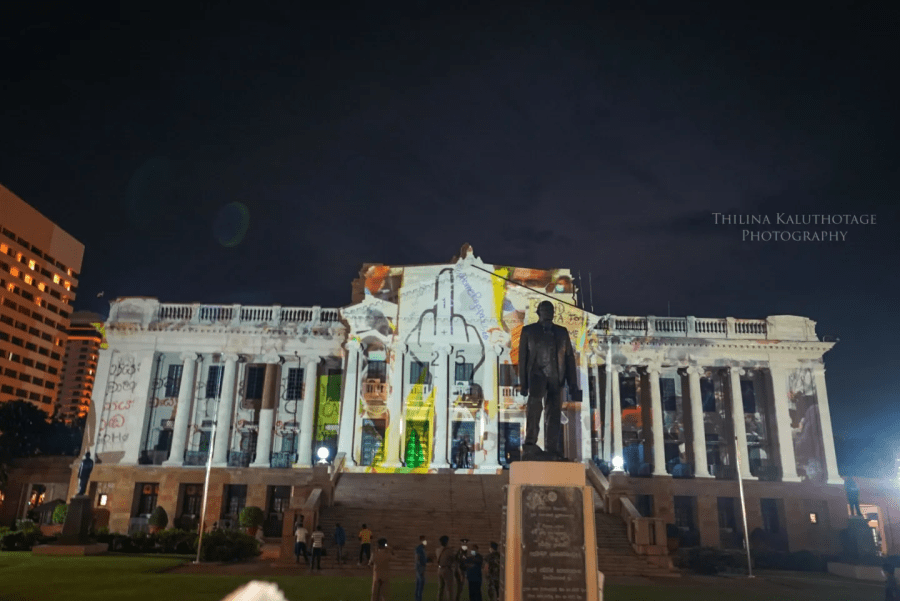
Aragalaya betrayed?: ‘The treason of the intellectuals’ in the age of populism
By Kumudu Kusum Kumara
Sri Lankans recently celebrated the fourth anniversary of the aragalaya, which some believe ushered in an era of Left populism in Sri Lanka. Left politics in Sri Lanka has been ravaged by a crisis since the late 1970s. It was basically one of an inability to regain the mass basis the Left lost in the 1977 elections. The Left was pushed out of the coalition government led by Sirimavo by the right-wing forces within it, in the context of the global oil crisis that led to the adoption of austerity measures by the government.
This crisis of the Left exploded with the mass uprising known as the aragalaya, which began with the hashtag campaign ‘Gota Go Home’. The nature of its development has come under scrutiny by critics who allege that hidden international hands orchestrated the movement. Nevertheless, the aragalaya—which developed into an authentic citizen action—ultimately ended in a counter-revolution. The current JVP/NPP government came to power by riding the wave of public awakening that accompanied the aragalaya.
Part I: Is the JVP/NPP government Leftist?
Even though the Western international media, as part of a strategy of manipulating the JVP/NPP government, has from time to time identified it as a Left government, the government does not identify itself as Left. It works very closely with the right-wing local capitalist class and international financial agencies.
Subaltern or elite?
While there was some initial attempt to identify the JVP/NPP government’s class basis as ‘subaltern,’ in the face of criticism, this formulation was changed to ‘non-elite.’ It is correct that, generally, members of the new regime do not belong to the strata of the political elite of the traditional aristocracy and bourgeoisie. However, it can be argued that those who are holding the leadership of the NPP government are those with the aspiration of becoming the new elite. They are the emerging political elite representing both the rural and urban petty-bourgeois strata.
The leadership consists of those who have risen to the top in professional fields and the bureaucracy, led by those in the fields of academia, medicine, engineering and technology, law, management, business, accountancy, and administration, alongside those who have traditionally been political activists and trade union leaders. Political power has been captured by these petty-bourgeois class elements that have embraced a technocratic ideology. Rallied around them is the capitalist leadership that directs chambers of commerce and is tied in with international capital. In essence, the current regime represents an alliance formed between the petty-bourgeois and capitalist groups and international finance capital—an alliance that, by now, has replaced the popular bloc formed with ‘janathawa’ (the people) during the election campaign leading to the formation of the government.
The new elite represents the heirs of the nationalist-Left tendency of the generation of the ‘56 daruwo’ represented by the JVP, a social force that Bandaranaike released in 1956. The mainstream of the political change of ’56 came to be represented by Bandaranaike’s own party, the SLFP, whose promise of building a common man’s era fizzled out with the regime led by Mahinda Rajapaksa coming to an end in 2015. At long last, true representatives of the rural and urban petty bourgeoisie have assumed political power after a long-drawn-out struggle, however, shedding their Left credentials in the process. This is the generation that Gunadasa Amarasekara, the doyen of jathika chintanaya, controversially hoped would take responsibility for the future of the country (“රටේ අනාගතය භාර ගන්නේ උගත් ගැමි තරුණ පරපුරයි”). While they have assumed political power, their formulation of what they call punarudaya (the Renaissance) seems to be at odds with Amarasekara’s wish to recover the ‘Sinhala Buddhist civilizational consciousness’—a point which requires a separate discussion at another time.
Some of the leftists who joined the NPP to form the government seek to justify their choice by claiming that the new regime stands for the two-stage revolution ‘a la Lenin’—that is, first, the bourgeois-democratic stage and then the proletarian-socialist stage; Sri Lanka will achieve industrialization in the first stage under punarudaya, or the Renaissance. What is not made clear is how Sri Lanka could industrialize while being under the grip of international finance agencies whose actions, economists argue, from the very beginning of their involvement in the Sri Lankan economy, have pre-empted even the remotest possibility of the country becoming an industrialized one. With its claim to bringing about economic stability and growth, the government has moved away from serving the genuine interests of the people and the country in the fields of economy, polity, and culture, as its critics point out, as briefly outlined in the next section of this article.
It is claimed that the theory of left populism was formulated in opposition to right-wing populism, which furthered the neoliberal agenda. Going by what is outlined below, can the JVP/NPP government be identified as a left-populist one?
Not economic democracy, but autocracy?
Left political parties, groups, and individuals in Sri Lanka widely hold that the crisis of Left politics has been intensified with the current government assuming power. According to their criticisms, the JVP/NPP government is not a Left government.
The current government entered into an agreement on debt restructuring with the IMF based on the conditions imposed by them, despite the expectations of the masses that rallied around the JVP/NPP election campaign and the promises made in its own election manifesto to renegotiate it. Accordingly, placing the larger burden of the haircut of the debt restructuring on the EPF of the working people has been carried out by the JVP/NPP government without any changes to the original plan.
It is apparent that the current government’s economic program from its inception has been directed by the leadership of the representatives of the capitalist class, led by the chambers of commerce. The government has been mainly formulating and implementing government policy based on the debt provided and the conditions imposed by the IMF and its affiliated institutions, the World Bank and the ADB, rather than on the felt needs of the Sri Lankan people.
An unbearable tax burden is imposed on the people. The government boasts that it has filled the treasury with trillions of rupees, including the wealth it has exploited via those taxes. Not only the poor but also the middle classes are oppressed by the unbearable burden of an ever-rising cost of living.
Poverty and malnutrition, which are major determinants of living standards, remain at high levels under the current government. According to official reports, twenty-five percent of the population lives in extreme poverty. Eighty percent of them live in rural areas. The poverty of the Tamil community living in plantations is even higher. Neoliberal economists themselves say that if calculated according to the real cost of living, the population living below the poverty line would be one-third of the total population. Women and children—and among them, girls—suffer the most from all this.
Sri Lanka’s micro-finance and credit crisis has trapped hundreds of thousands of people, mainly rural women, in a deep debt trap through predatory high-interest loans, leading to over 200 reported suicides. Activists have already expressed fears that the Microfinance and Credit Regulatory Authority Act, recently passed by the government, is designed to blame victims and will contribute to the erosion of consumer protections in such a regulatory framework by placing the onus of protection on borrowers. They stress that the Act does not include sufficient provisions to protect micro-finance and credit consumers.
Critics point out that not only our economic sovereignty but also our political sovereignty and security have been compromised by the secret agreements signed by the current government with the global American empire (US-Sri Lanka Security Memorandum of Understanding/Government Partnership Program (2025)) and the regional Indian power (India-Sri Lanka Security Partnership Agreement (2025)). This government is strengthening relations with Israel—a nation that has embarked on a policy of genocide against Palestinians—and is maintaining cooperation with Israeli intelligence agencies and the military.
The current government has declared the private sector and the market mechanism, not the state sector, as the engine of economic growth at a level surpassing previous governments. The government has accepted the neoliberal vision of subjugating large areas of social life to the logic of commodification. By allowing the market to behave as it sees fit, people have been subjected to the ruthless control of the market, except in the case of a few essential goods.
Critics have accused the current government of subtly but carefully implementing the privatization of state-sector institutions, a move that the previous government had withheld in the face of public opposition. Services essential to the survival of ordinary people and the middle class, such as public healthcare and education, are increasingly being brought under the influence of the market. There is no clear attempt to free passenger transport from the clutches of a rapacious private sector. The energy sector—oil and electricity supply—continues to be driven towards privatization through fragmentation.
It is instructive here to note what Bhaskar Sunkara, editor of Jacobin—the popular Left magazine published in New York that strongly backed Zohran Mamdani’s bid for Mayor—has to say on social infrastructures:
“Health care, education, transportation, energy, and telecommunication are not consumer goods but social infrastructures on which participation in modern life depends. Organizing them through profit-seeking intermediaries that ration by price rather than need introduces predictable distortions. The result is a system that undermines both equality and efficiency. Decades of comparative experience suggest that public provision in these sectors can deliver better outcomes at lower social cost, precisely because it aligns provision with social need rather than purchasing power.” (‘We Need a Socialism After Capitalism,’ Jacobin, April 2026)
Serious damage to the natural environment and biodiversity continues under the current government. Deforestation, fragmentation of wildlife habitats, and human-wildlife conflicts have intensified. The release of protected lands to local and foreign private investors for so-called development, ignoring environmental impact assessments (for example, the Mannar wind farm projects), and the failure to stop illegal land acquisition and sand mining, which have undermined biodiversity, especially in the dry zone, are continuing.
The introduction of a biometric national identity card, funded by an Indian grant, in conjunction with the massive digitalization program launched under the private sector operation, poses a serious risk of being used to unnecessarily restrict individual freedoms and to be used by the Sri Lankan government and foreign states to suppress citizens when necessary. Overall, it is clear from global experience that digitalization, in the name of national security, is building a surveillance state.
Part II: Undermining the democratic political framework
The JVP/NPP conceptualization of the ‘jathika punarudaya’ (national renaissance) interpreted the Sri Lankan Renaissance as the aspiration to regain the moment we lost in the global modernization project, which is believed to have emerged in the twentieth century as a result of the Western European Renaissance and Enlightenment imagination. Jathika punarudaya values modernity as the era of citizens based on a representative democratic model founded on a common social contract. It values human rights, civil rights, and political rights as the core of modernity. It values social interventions based on the values of social justice and collectivism. But is the current government acting on the basis of those renaissance beliefs that they claim to believe in?
This government came to power within the framework of bourgeois parliamentary democracy. However, the opposition alleges that the government is working to limit the right of the opposition to question the government’s actions within that framework, and within Parliament itself. The continued postponement of provincial council elections by the government has been criticized as a delay in the implementation of decentralized political power, especially in provinces inhabited by Tamils and Muslims.
The promise to abolish the executive presidency and restore a parliamentary-based political power structure continues to be postponed. This has drawn attention as a possible way to suppress trade union activities and intimidate political activists through repressive laws such as the Public Security Act and the Emergency Law, which are continuously implemented through the authoritarian use of the power of the executive presidency.
‘Honest party leadership,’ not the institutional system
The JVP, the core political party of the current government, which insists that its members are honest, claims that even if they violate certain rules and regulations in the course of governing, there is nothing wrong with it because it is not done for personal interest but for the common good. This implies that this government does not rely on rules, regulations, and a system of institutions built to last, but rather on the leaders of its own party, the JVP, whose leaders believe themselves to be honest. The system of institutions established on rules and regulations is for the rest of the people.
Attempts to subjugate institutions and public opinion to the government’s opinion
It is apparent that the government wants to implement its pre-designed agenda without any hindrance. To that end, the government is trying to subjugate all institutions and public opinion to its sole opinion. The most striking example of this approach is the government’s attempt to implement, without any genuine public discussion, neoliberal reforms formulated by previous governments regarding national education, which will have a decisive impact on the future of the country. The leadership brags that the proposed education reforms will be implemented as originally designed, regardless of any criticism or objections.
The government sets up committees at the local level claiming to represent the public, but people complain that they exclude anyone who does not conform to their way of thinking.
Freedom of expression
Civil rights activists say the current government’s continued use of the Online Safety Act, which was passed by the previous government despite public opposition, poses a serious threat to freedom of expression. Freedom of expression has been suppressed under the guise of legality. The government has made it a policy to summon and question individuals who criticize the government—even national-level politicians—at the CID. This amounts to intimidating its critics.
The government has not only broken its promises by failing to repeal the existing PTA but is also attempting to pass a new anti-terrorism law that local and international civil rights organizations have unanimously condemned as even more repressive. It has been stated that there is scope for the proposed new law to intensify the current use of anti-terrorism law as a weapon to suppress freedom of expression.
“The Arts Council has become an arts police!”
The latest instance of the government’s attempt to curb freedom of expression that has come under serious public criticism is the detention of four books by a Sri Lankan writer, Theebachelvan, who writes in Tamil, by Sri Lankan Customs when they were brought into the country from India. Later, a statement issued by the Director of Customs said that two of the novels would be released based on recommendations issued by the National Arts Council and the Literary Council, while the other two would not be released based on the recommendations of those boards and the Ministry of Defense.
The statement that “The Arts Council has become an arts police!” sums up the public protest that arose questioning the “legal and moral rights of the members of the Arts Council and the Literary Council who have received political appointments” to “measure and mark the boundaries of freedom of speech and expression at their own discretion” by giving such recommendations and assuming a power that they do not have.
Going beyond this general situation, the serious question that has been raised is: on what basis did Customs consider the views expressed in the two books by Theebachelvan that have been censored to be equivalent to the crime of ‘sedition’ under Section 120 of the Penal Code, which was cited as the reason for the detention? A related question is whether there is a connection between the allegation of sedition and the fact that the writer is a Tamil from Kilinochchi.
The irony here is the intervention of the current government’s Minister of Culture, the heads of the Arts Council under the Ministry of Culture, and its own literary sub-council in deciding this matter, along with the follow-up statements defending the government’s decision made by the same authorities, as well as by writers, artists, intellectuals, and academics who have been holding positions under the current government and those who have not.
There was strong public criticism that these individuals—who were believed to have held radical, liberal views on freedom of expression and ethnic rights before the current government came to power—have been appointed to various positions under the current government and now approve its repressive decisions in the name of ethnic reconciliation.
The following sentiments extracted from the comments made by Sumathy Sivamohan on her FB page, expressing her shock at a statement made by one of the leading Sinhala writers involved in making such statements, encapsulate the essence of the public criticism of the issue:
“I am shocked at [name of the person]’s words on the detainment of Theebachelvan’s works by Customs. … The radicalness, the liberalness, are just thin veneers of their Sinhala-only stances. …. Now, they talk of Reconciliation. Reconciliation via Repression. …. Reconciliation, my foot!!!!! ….. reconciliation is in your head, I think…. [I am] outraged. But now, [I] am certain of one thing. This is the bluff and bluster of liberals. …. That [name of the person] and others think, when Sinhala people think there’s reconciliation, there’s reconciliation, smacks of very deep-rooted racism…..
I don’t understand the argument, ‘we have to protect this government’ sentiment, touted by many liberals, who in intimate circles voice criticism. And these are the same people who supported the LTTE too, when it suited them—their liberal Sinhala agendas. … Now, they are blubbering….. it is shocking, for it whisks the mask off the faces of these liberal faces. There is a side of Sinhala liberalism that slavishly supports sentiments pertaining to the LTTE. They are the same, they are all the same. Those radicals, those liberals, those everybody, who think because they are Sinhala they have superior knowledge of matters. Sickening.” (reproduced with permission)
Part III: The social media
The JVP/NPP government, which relied heavily on social media to come to power, seems to be deeply afraid that the government will be overthrown by a second aragalaya fueled by social media. The government has been accused of organizing and directing forces—including pro-government social media activists—from behind the scenes to prevent criticism of the government’s actions from shaping public opinion against the government through social media. Critics say that the aim is to discourage, silence, and drive away critics of the government through ridicule, insults, obscene statements, and intimidation.
Leaving aside these behind-the-scenes maneuvers, the news that a group of YouTubers, who are identified as “dhobies” or “washers,” recently attended a private press conference at the JVP party headquarters at the invitation of the President and the Minister of Mass Media and Cabinet Media Spokesperson, is a powerful example of the weight the current government places on social media.
“Dhobies” / “washers”
The intelligentsia and intellectuals in democracies play a key role in shaping public opinion, which is traditionally important in determining the outcome of elections or in building public protests. In the era of social media ubiquity, the primary location of the intelligentsia engaged in politics has shifted to social media. Influencing social media users is now seen as the key to political victory—hence the significance of the phenomenon identified by the term “dhobies”/“washers” (literally laundrymen).
Manifested as a voluntary social media activity—dominated by Facebook and primarily occurring in the Sinhala medium (this article does not cover Tamil social media)—the phenomenon of “washers” is an unprecedented and unique addition to the political process in Sri Lanka. This is an activity of political significance with a certain level of intellectual content that goes beyond the level of mere social media activism, and is carried out by the intelligentsia and intellectuals. These “washers”, alongside the academics who lead them, emphatically state that it is their responsibility to work vigorously to protect this government—one that they brought to power and which aligns with the ideology they believe in.
This group also includes social media journalists who identify themselves as left-wing political activists and as ‘analytical’ discussion presenters via content creation—podcasts and video interviews—as opposed to being mere social media activists.
To achieve their goal, the “washers” understand their role as “cleaning” or “whitewashing” the government in the face of criticism or controversy. They seek to prove the government right by targeting, attacking, and silencing critics through quibbling and intimidation, thereby “protecting” the government.
Although these attacks primarily come in the form of “intellectual” attacks, the range of attacks unleashed under that “intellectual leadership” includes ridicule, insults, and harassment, which are encouraged to be directed at opponents at various levels. Posts are published subtly or directly inviting the “people” who habituate social media as “friends” to post their emojis—likes, dislikes, laughter, ridicule—which may take the form of reaction images, or verbal “comments” against political opponents who publish their views on social media.
In addition to organized “washers,” there are highly credentialed academics who contribute to the “washing” process on their own Facebook pages, either directly or in tacit, subtle ways. Those who do not actively join indicate their support tacitly as “friends” of the organized “washers”—either via emojis or by participating through seemingly innocuous comments that nevertheless get the job done.
They claim this activity of ‘washing’ is the real ground on which politics is determined today. Their stated argument is that in the current era of social media, ridicule, insults, and harassment are inevitable in politics; therefore, those who cannot face them should not be involved in politics. In other words, in this view, politics dominated by social media seems to reenact Hobbes’ “state of nature,” which is “nasty, poor, solitary, brutish, and short,” indicating an unprecedented level to which Sri Lanka’s intellectual culture has descended.
Isn’t it an indictment of academia that the practice of “washing” led by academics comes under serious scrutiny from their academic “friends” on social media, especially in relation to the vocation of intellectuals and their role in politics? Notably, the self-identified intellectual leaders of left populism—some of whom are themselves drawn from academia—circulate within these same social media circles.
What they are trying to protect the government from, by silencing their rivals and banishing them from the public arena, is a second aragalaya that they and the government seem to firmly believe will build on social media operations if criticism of the government is allowed to spread unabated. Hence, there is the need to somehow suppress criticism while giving the act a veneer of intellectual activity. They are participating in this effort, rallying as both organizations and individuals at different levels.
It needs to be added that while these “washing” activities take place mainly in the medium of Sinhala, related “higher” intellectual content is aired in the English medium as well, mainly in the form of interviews with academics.
Criticizing the government from a left political perspective
What has come to be expressed as the essence of this “washing” process is the idea, presented in the form of a theoretical formulation, that when criticizing the current government from a leftist political perspective, one should first consider who benefits from it. What it means is that if the current government is criticized from a leftist perspective, it could result in a second aragalaya, leading to the return of those who are currently out of power.
A related question that critics are often asked is: who do they see as the leaders of a government that could replace the current government? It is as if citizens should only criticize a government that affects their lives if they have a clear alternative to replace it. It is as if criticism is not something that can be done with the intention of correcting something, or a way to develop an alternative.
This argument rejects the traditional liberal political science argument about bourgeois democracy, which considers holding elections at regular intervals to bring governments to power and changing governments when necessary as positive—which requires accepting as positive the development of a critique of the government in power. Accordingly, it implies that the current government must be kept in power at all costs to prevent the power groups that the people rejected from coming back to power, and that is why the Left should stop criticizing the current government. This is a very strange idea of democracy. It is clearly not the bourgeois liberal democracy we have known so far. So, what kind of democracy is it? As some are wont to do, we can keep on tweaking the term to suit the changing conditions instead of developing a critique in the name of the ideal of democracy. So, what is the new term for what is done with democracy under the new regime? Or do they think that we have reached an era of post-democracy?
Traditionally, the role of intellectuals and the intelligentsia has been to provide the critical thinking that society needs. But the intellectuals who are engaged in “washing” say that the Left should silence its criticism in order to save the government, and then everything will be fine. Some who support “washing” argue that what the Left should do is not criticize the current government, but push it further to the left. While this argument presumes the government to be Left notwithstanding the Left criticism of it, what it fails to take into account is that one of the reasons the government needs repressive social media forces and “washers” may be that the government is intolerant of criticism that pushes it to the left.
The NPP government came to power by rallying around the NPP organizations and individuals who called themselves liberal, progressive, leftist, radical, etc., outside of the JVP membership. The group that can be called intellectuals among them identified themselves with the NPP through a series of actions—starting from contributing to the work of building the National People’s Power and the formulation of its policies, to taking the leadership of relevant committees at various levels and appearing publicly at various public events of the NPP, even on the election platform. Some of them won the elections on the basis of their identity-based vote blocks or became members of parliament from the national list and even became ministers. Many others, as is customary after an election victory, got themselves appointed to various positions in the government bureaucracy as chairmen/women, board/council members, directors, etc., either immediately or later.
Some, whether or not they were appointed, abandoned the critical role they were previously playing in society and have remained silent. Some of them have abandoned the theoretical interventions they were making in the public arena with a view to a “system transformation” until they brought the current government to power, in favor of safe literary or other topics, as if the transformation that all those criticisms targeted had been achieved with the coming to power of the current government. Others entered the “washing” business while holding official positions in the current ruling regime. Although not all those involved in the “washing” process are in positions of power, there have been allegations that some of those who are involved without holding positions do so in exchange for payment. Among these groups are those who, traditionally known as independent journalists, are now mostly known as content and/or digital creators, questioning the validity of their claims to represent independent journalism.
Some leftists assume that this will be the last time a left-wing government comes to power in Sri Lanka, and therefore have joined the government believing that they should join this government and achieve the maximum good that can be achieved for the people, as if they think that history has ended.
Conclusion: Populism and the treason of intellectuals
In conclusion, returning to the ideology of populism that provided the backdrop for this article, it is relevant to note how some of the key characteristics of populism identified in the literature align with critics’ accounts of the policies followed by the current JVP/NPP government.
At its core, populist ideology presents a dichotomy between a “pure,” idealized conception of the people and a “corrupt” elite. It frames politics as a moral struggle against corruption, seeking to displace the traditional class basis of politics. Being deeply anti-institutional, populism dismisses expert and academic knowledge as elitist.
Driven by a Schmittian logic of friend-versus-enemy politics, populist leaders and the intelligentsia seek to displace the traditional elite, aiming to purge them from politics, academia, and culture with a view to appointing themselves as the new elite.
Populism rejects the democratic state in the name of the people. Political theorist Wendy Brown points out that populism focuses instead on aggressive law and order, statism, and a non-democratic view of liberty—where authority rules, yet individuals claim libertarian freedom.
Globally, populism tends to breed authoritarian leaders who centralize power in the executive branch, stripping judges of their independence and turning elected parliaments into mere rubber stamps. To stay in power, populist movements systematically target checks and balances, the free press, and universities, labeling them as roadblocks against the people’s mandate. Once in control, these regimes use legal gray areas to oppress opposition parties and subvert democracy to ensure they remain in power.
The Treason of the Intellectuals
For the title of my article, I have borrowed the title of a seminal work by the French philosopher and essayist Julien Benda, The Treason of the Intellectuals (1927). Almost a hundred years ago, Benda critiqued the intelligentsia’s betrayal of their vocation as intellectuals, focusing on their abandonment of the Enlightenment ideal of universal humanity. In our case, I would argue that intellectuals have abandoned their vocation in the very name of the “renaissance” and “enlightenment” ideals—or the punarudaya—they claim to stand for, allowing political partisanship to dictate their understanding of the intellectual vocation itself.
In her 2023 book Nihilistic Times, political theorist Wendy Brown argues that we are living in deeply nihilistic times. Placing this rise in nihilism at the very center of our current political crisis, she warns that it is actively undoing democracy while degrading and confounding both political and academic life. In Brown’s view, nihilism leads to the devaluation of both knowledge and political responsibility—a crisis that is especially clear in academia. She argues that intellectuals have abandoned democracy, the common good, and the pursuit of objective truth, choosing instead to align themselves with whoever holds political or cultural power to serve partisan or authoritarian goals. Ultimately, Brown argues that public intellectuals must act as honest, thoughtful analysts who hold politicians accountable rather than seeking to win their favor. Finally, she issues a direct challenge to left-wing intellectuals to make good on their foundational commitment to true critical thinking.

